

About the Hackathon
Healthcare technology is part of everyday life. Easily accessible, high-quality, and empathetic medical solutions are essential to a modern society. To propel Hong Kong’s development into a premier hub for health innovation, the vision for HKUST’s new Medical School is being championed to facilitate the bridging of medicine and engineering for the betterment of the general public.
Consider how healthcare technology is used when monitoring vitals with a mobile device, consulting doctors online, or managing daily wellness routines. MedTech is the intersection where compassion meets computation, applying engineering solutions to genuine clinical pain points. For instance, the optimization of hospital operations and the enhancement of elderly care and mental health are examples of applied medical technology. Through these innovations, our healthcare systems can be better understood and enhanced, fostering a healthier and more resilient environment.
Why Join?
The HKUST Future MedTech and Health Hackathon is designed to inspire secondary school students to explore how technology, compassion, and innovation come together to shape the future of healthcare. Through hands‑on activities, real‑world problem solving, and close interaction with healthcare professionals and university mentors, students gain meaningful early exposure to medical and engineering pathways while developing essential skills for the future.
Real‑world exposure to healthcare and MedTech
You get to work on authentic healthcare problems shared by patients, caregivers, and frontline professionals.
Hands‑on learning beyond coding
Activities include design thinking and low-fi prototyping. All beginner friendly.
Empathy-driven and human-centered experiences
Through design interviews, you will learn to design solutions with compassion and user understanding.
Guidance from experts
You will receive direct feedback and mentoring from experts in the field of healthcare.
Early insight into university pathways and future careers
The hackathon showcases HKUST Engineering and the new Medical School vision
Confidence, and personal development
You will gain presentation experience and teamwork skills
Themes of the Hackathon
- Elderly Care & Ageing-in-Place: Focuses on falls prevention, medication adherence, and social isolation.
- Preventive Health & Public Health: Focuses on health literacy, vaccination uptake, and chronic disease prevention.
- Clinical Tools & Diagnostics: Focuses on point-of-care devices, telemedicine, and monitoring.
- Mental Health & Wellness: Focuses on stress management, youth mental health, and access to support.
Awards and Prizes
Teams from each theme would have the opportunity to compete for the following awards:
Top Three Awards
Gold, Silver and Bronze
Special Category Award
Best MedTech Innovation Award
Awarded to most outstanding team from the Gold Award winners
Post‑Event Opportunities (To be Confirmed)
The organizing committee is exploring potential post-event opportunities for outstanding teams. Any opportunities offered, including mentorship or follow-on activities, will be subject to availability and confirmation. Further details will be announced when finalized.
Who Can Join?
The hackathon is open to Form 3 to Form 6 secondary school students, with no prior experience in coding, medicine, or engineering required. Students with interests in science, technology, design, healthcare, AI, or social impact are all welcome.
Team composition
Students participate in teams of four. Teams are encouraged to be interdisciplinary, bringing together different interests and strengths (e.g. creativity, problem‑solving, communication, technical curiosity).
School participation
Each school may nominate 1–3 teams to join the hackathon.
Inclusiveness and accessibility
The program is designed to be beginner‑friendly, focusing on learning, empathy, and teamwork rather than advanced technical skills. Participants will be supported through workshops, mentors, and structured activities ensures everyone can participate meaningfully.
Pre-Event Activity
Before the on‑campus hackathon, students can join a webinar that introduce real healthcare challenges, and build early understanding of the themes. This is so that students arrive better prepared, more confident, and ready to engage meaningfully from the start of the hackathon.
Wednesday, 8th July 2026
7:00 pm to 8:00 pm
Webinar
Hackathon Briefing
Introduce key themes of the hackathon
The Programme
The hackathon features a two‑day immersive main programme, supported by a pre‑event online activity that introduce real healthcare challenges in advance. During the main event, students work in teams to explore themed problem areas, engage with healthcare professionals, attend hands‑on workshops, receive mentorship, and develop prototypes. The programme concludes with structured pitching sessions, where teams present their ideas to expert judges, emphasizing learning, collaboration, and real‑world impact.
In parallel to the Hackathon programme, we will also be hosting a separate biomedical themed workshop - Biohacking Challenge on Friday, 10th July 2026. Details can be found here.
Date |
Phase |
Details |
| 8 July 2026 | Pre-Event |
|
| 10 July 2026 | Day 1: Empathy & Ideation |
|
| 11 July 2026 |
Day 2: Build & Convince |
|
Session 1: Empathy and Ideation (Friday, 10th July 2026)
Morning Session: Empathy & Ideation
The exact venues in which activities will take place are shown in "Details".
Time |
Activity |
Details |
| 8:30 am - 9:30 am | Registration and Check-in | Students receive T-shirts, name tags and souvenir (Participants taking part in the Biohacking workshop register at 8:30 am) |
| 10:00 am - 10:10 am | Hackathon Introduction |
Citigroup Lecture Theater (Lecture Theater A) |
| 10:10 am - 11:15 am | Welcome Address and Keynote Speech |
Citigroup Lecture Theater (Lecture Theater A) |
| 11:15 am - 11:30 am | Break | |
| 11:30 am - 12:30 pm | Design Thinking Workshop |
Citigroup Lecture Theater (Lecture Theater A) |
| 12:30 pm - 1:30 pm | Lunch |
Academic Concourse Outside Lecture Theater D |
Afternoon Session: Deep-Dive & Ideation
The exact venues in which activities will take place are shown in "Details".
Due to lack of demand, there will be NO overstaying option.
Time |
Activity |
Details |
| 1:30 pm - 2:00 pm | Briefing Session |
Citigroup Lecture Theater (Lecture Theater A) |
| 2:00 pm - 3:30 pm | Brainstorming Session OR Seminar (Optional) "Reach for the Stars: Aerospace Innovation and the Future of Space Exploration" |
Academic Concourse |
| 3:30 pm - 5:00 pm | Ideation and First Sketch / | Academic Concourse (Light refreshments are provided) |
| Concurrent Sharing Sessions by Experts |
|
|
| Netflix Movie Showing "Bleeding Edge" |
Citigroup Lecture Theater (Lecture Theater A) |
|
| 5:00 pm - 6:00 pm |
The Pit Stop - Mentorship Carousel First Day Wrap up |
Academic Concourse |
Session 2: Build & Convince (Saturday, 11th July 2026)
Morning Session: Refinement & Prototyping
The exact venues in which activities will take place are shown on the "Details".
Feel free to have lunch any time, as lunch coupon will be provided in advance.
Time |
Activity |
Details |
| 9:00 am - 10:00 am |
Day 2 Kick-Off: "From Feedback to Forward" Discussion with HKUST students |
Academic Concourse |
| 10:00 am - 12:30 pm |
Build Sprint and pitch practice |
Academic Concourse |
Afternoon Session: Final Preparations & Judging
The exact venues in which activities will take place are shown on the "Details".
Feel free to have lunch any time, as lunch coupon will be provided in advance.
Time |
Activity |
Details |
| 12:30 pm - 1:00 pm |
Final Pitch Preparation Final rehearsals + Submission of slides/prototypes |
Academic Concourse |
| 1:00 pm - 3:30 pm | Final Pitch Competition: The Dragon's Den |
Format: 3 - 5 minutes pitch + 10 minutes Q&A per team. (Parallel Session) |
| 3:30 pm - 4:00 pm | Judges Deliberation + Student Networking | |
| 4:00 pm - 5:00 pm | Awards Ceremony with Group Photo (Hackathon and 10A Logo Competition) |
Chiang Chen Lecture Theater (Lecture Theater J) |
Venue
The hackathon will be taking place in the Hong Kong University of Science and Technology (HKUST)
How to Get There
MTR
The best MTR stations for transport to HKUST are: Choi Hung, Hang Hau, and Po Lam.
This MTR route map helps you locate the stations.
BUS / MINIBUS
Most of buses to HKUST leave from different MTR stations and bus terminals:
Buses let you off at main entrance
From Choi Hung MTR station: 91 or 91M bus (use Exit C2); 11 minibus (use Exit C1)
From Hang Hau MTR station: 11M minibus (use Exit B1)
From Tiu Keng Leng MTR station: 792M bus (use Exit A1)
From Sai Kung bus terminus: 792M bus; 12 minibus
Buses let you off at southern entrance
From Hang Hau MTR station: 91M bus (use Exit B2); 11 minibus (use Exit B1)
From Po Lam MTR station: 91M bus (use Exit A2); 12 minibus (use Exit B1)
From Ngau Tau Kok MTR station: 104 minibus (use Exit A)
TAXI
Taxis are easily available at any MTR station, from hotels and most areas of Hong Kong. Taxis can let you off at the Entrance Piazza.
DRIVING
From Hong Kong Island
Take the Eastern Harbour Crossing towards Lam Tin. Continue straight after the roundabout, and get in the right lane towards the Tseung Kwan O Tunnel. After crossing the tunnel, follow signs for Hang Hau and Sai Kung. You will see signs pointing to University after passing Hang Hau. Then follow Ying Yip Road, Clearwater Bay Road; at the gas station, turn right, go straight. You will be at the Southern entrance to HKUST.
From Kowloon
Head to Choi Hung Interchange via Prince Edward Road, Kwun Tong Road or Lung Cheung Road. At Choi Hung, follow signs to Clearwater Bay Road. You will see signs to University after about 5 minutes drive on Clearwater Bay Road.
From Shatin and the New Territories
Take the Tate’s Cairn or Lion Rock Tunnel towards Kowloon, staying left onto Lung Cheung Road and head towards Choi Hung Interchange. Follow signs to Sai Kung. Take Clearwater Bay road, and follow signs to University.
Parking
Non-HKUST community members (for example, JULAC card holders) must use the public car park near the Southern Entrance. Contact the campus security at 2358-6483 or click here for rates, registration and any parking-related questions.
For a detailed guide to HKUST, please refer to https://hkust.edu.hk/visit
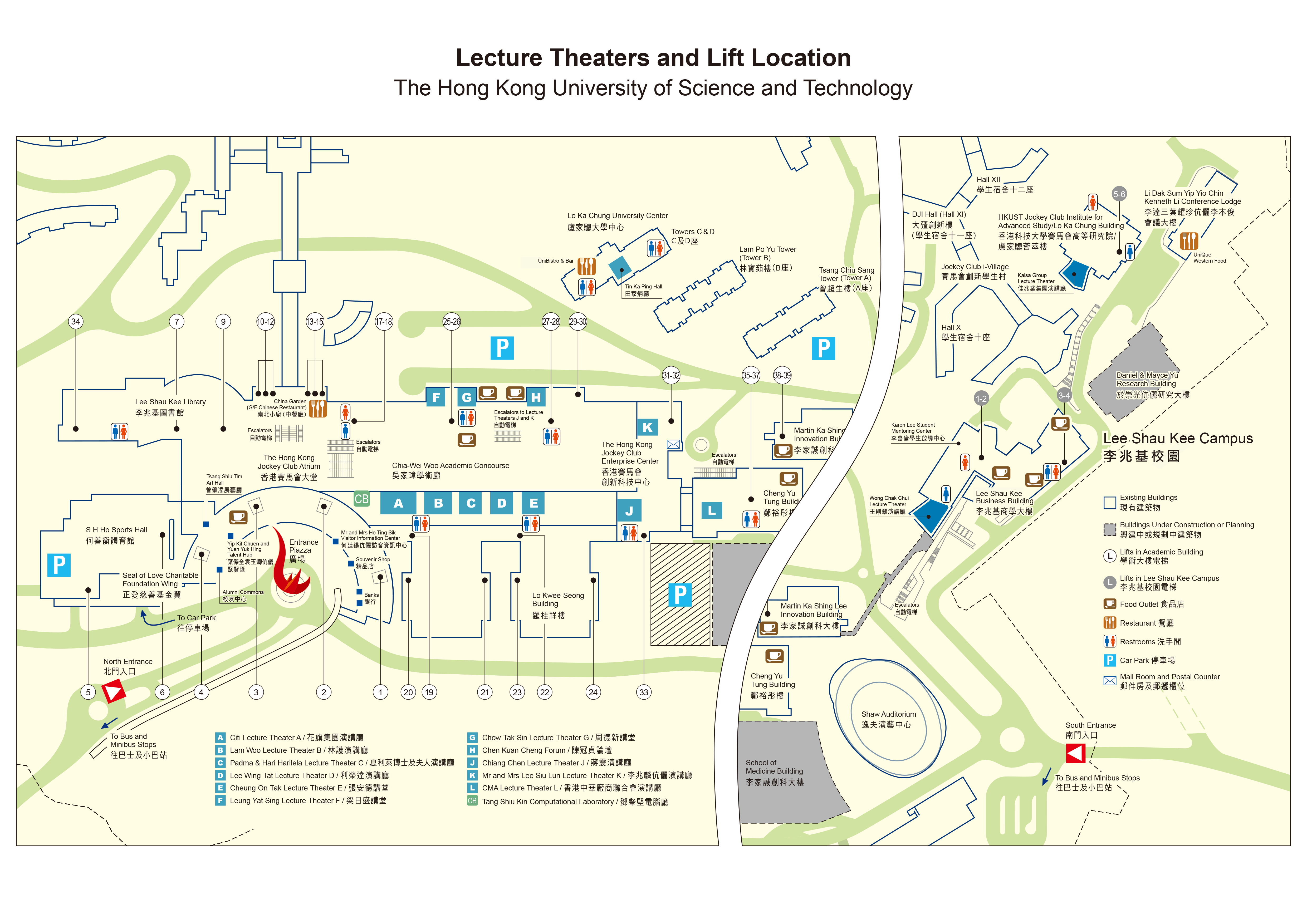
You may refer to the map below on the locations of all the lecture theaters within the HKUST campus.
Organizing Committee
Prof. Chi Ying TSUI
Professor
The Hong Kong University of Science and Technology
Prof. Ben Yui Bun CHAN
Professor of Engineering Education
The Hong Kong University of Science and Technology
Prof. Kam Tim WOO
Professor of Engineering Education
The Hong Kong University of Science and Technology
Prof. Marshal Yuanshuai LIU
Associate Professor of Engineering Education
The Hong Kong University of Science and Technology
Dr. Hiddadura Isura Malinda M. ABEYNAYAKE
Lecturer
The Hong Kong University of Science and Technology
Contact Us
Academy for Bright Future Young Engineers
Address
Room 2396, 2/F, Lifts 17/18, Academic Building, HKUST, Clear Water Bay
Phone
3469 2618
abfye@ust.hk